Superposition Isn't "Both at Once": Here's What It Really Means
Why "a qubit is 0 and 1 at the same time" breaks your intuition, what a quantum state actually is, what measurement does, and a better mental model for superposition.
By QuantumX Foundation5 min readOriginally published on LinkedIn
On this page
Popular science has handed a generation of engineers and founders a broken mental model of quantum mechanics.
It's time to fix it with precision, not hand-waving. Every few months a new article explains how quantum computers are "exponentially powerful because qubits can be 0 and 1 at the same time." The phrase is everywhere. And it is wrong in a way that genuinely matters.
We are not being pedantic. The "both at once" shortcut produces broken intuitions about what quantum algorithms can do, why entanglement is strange, and why measurement is irreversible.
Once someone internalizes that framing, the real concepts become harder to learn, not easier. So let us clear it up from the ground up.
The myth: "a qubit is 0 and 1 simultaneously"
Walk through the logic of that claim. A classical bit is either 0 or it is 1. Those are mutually exclusive states. So when someone says a qubit is "both 0 and 1 at the same time," they are implying the qubit holds two classical states at once, like a coin being simultaneously heads and tails while it sits flat on a table.
That picture is not quantum mechanics.
It is the superposition of two classical values treated as a filing cabinet with two contents. The qubit does not secretly know which value it has and refuse to tell you.
There is no hidden value at all before measurement. The quantum state is a fundamentally different kind of object from a classical state, not a smeared-together version of two classical states.
What a quantum state actually is: probability amplitudes
A qubit in superposition is described by a quantum state written as:
|ψ⟩ = a|0⟩ + b|1⟩
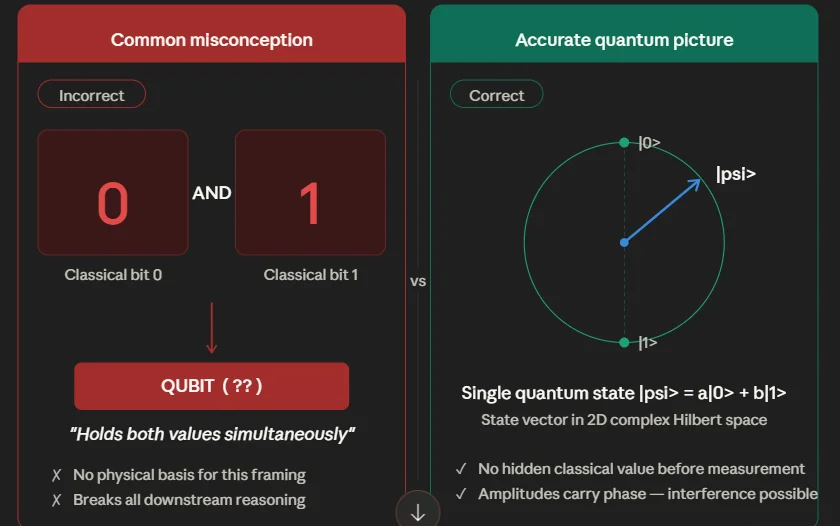
The amplitudes are complex numbers, not probabilities themselves. This distinction is not cosmetic. Because amplitudes are complex, they can interfere with each other constructively or destructively, just like waves.
That interference is the engine behind quantum algorithms. It cannot be replicated by any story about "having two values at once."
The state |ψ⟩ is a complete description of the qubit. It is not incomplete in the sense of hiding a classical outcome. It is a different kind of physical thing from a classical bit, and it requires its own language.
The spinning coin: a useful but limited analogy
While a coin spins, you cannot say it is heads or tails. Only when it lands do you find out. This captures one real feature of superposition: the outcome is genuinely undetermined before measurement. The analogy breaks down quickly, though.
Where the coin analogy works:
- The outcome is not known in advance.
- Only one outcome appears when the process ends.
Where the coin analogy fails:
- A spinning coin has a definite physical state at every moment. Quantum indeterminacy is not uncertainty from incomplete information.
- Quantum amplitudes can interfere. A spinning coin has no interference. This is the crucial feature the analogy erases entirely.
- The coin is a classical object governed by classical physics. Treating a qubit as a coin with unknown orientation misses the whole structure of quantum mechanics.
What measurement actually does
When you measure a qubit in the state a|0⟩ + b|1⟩, the result is 0 with probability |a|² and 1 with probability |b|².
After measurement you get exactly one outcome, and the superposition no longer exists. This is called collapse.
The collapse is not a disturbance you should try to avoid. It is how information leaves the quantum system and enters the classical world you can read. Quantum algorithms are designed to set up superpositions, apply transformations that manipulate the amplitudes through interference, and then measure at exactly the right moment to read out the answer with high probability.
Why the misconception causes real problems
The "both at once" framing leads to specific errors that come up in conversations about quantum computing every week:
- The parallelism fallacy. "A quantum computer with n qubits checks all 2^n possibilities simultaneously." It does not. Measurement returns one answer. The art of quantum algorithms is structuring interference so the right answer has high amplitude when you measure.
- Entanglement confusion. If you think superposition means "holds multiple classical values," entanglement looks like a magic communication channel. It is not. Entanglement is a correlation between measurement outcomes. No classical information travels faster than light.
- Quantum speedup misread. The real source of quantum advantage is the ability to run structured interference on amplitude distributions, a kind of computation with no classical analogue. That story is invisible if your mental model is "doing 2^n things at once."
- Quantum error correction misread. When people think qubits secretly hold two values, error correction sounds like it just picks the right one. In reality, the challenge is preserving quantum coherence, a completely different engineering problem.
Superposition is not about storing multiple answers. It is about computing with probability amplitudes that can interfere.
A better mental model
Here is a frame that is both accurate and genuinely useful for a technical audience:
A qubit in superposition holds a quantum state: a set of complex-valued amplitudes over possible measurement outcomes.
The amplitudes encode not just probabilities but also phase relationships that allow interference. The state is complete. There is no hidden classical value. When measured, one outcome is produced: probability equals squared amplitude magnitude.
The superposition does not survive measurement.
This model is more complicated than "both at once," and that is fine. The real concept is genuinely richer. The reward for carrying a slightly heavier mental model is that quantum interference, quantum algorithms, and the limits of quantum computing all become coherent rather than magical.
It also answers the question that the "both at once" framing leaves open: why can't we just read both values? Because there are no "both values." There is one quantum state, and measurement converts it into one classical outcome. The richness of quantum computation lives entirely in what happens to the amplitudes before you measure, not in some vault of simultaneous answers waiting to be unlocked.
If you want to see the same ideas built up visually, with the Bloch sphere and measurement step by step, read Qubits Explained: From Bits to Quantum Bits in 10 Minutes.
If you want a place to start, the QuantumX Roadmap is a good first step, and the next QuantumX meetup is probably closer than you think.
Start your quantum journey with hands-on learning at QuantumX School.